Projects
Parental Knowledge of Early Adolescents’ Online Social Lives: The role of Parental Mediation (PARKA)
Project plan and objectives
In the PARKA project, we investigate how parental mediation (i.e., parenting strategies aimed at regulating children's and adolescents' use of digital technologies) relates to parents' knowledge of what their adolescent children do online.
Family psychology research shows that parental knowledge of children's whereabouts is associated with positive psychosocial adjustment of these children and adolescents. This is closely connected to adolescents' willingness to disclose information about their lives to their parents - whether they share it or hide certain aspects of their lives.
However, relatively little is known specifically about parental awareness of adolescents' online lives. How much do parents of early adolescents actually know about their children’s online activities and experiences? Do different parental mediation strategies help parents improve this knowledge? Can some of these strategies backfire and make adolescents conceal information about their online activities? What prevents adolescents from confiding in their parents when they experience something harmful online? Which online activities and experiences do teenagers consider private and none of their parents' business? And do parents feel the same way?
These are the questions we focus on in the PARKA project. To address them, we will use data from our previous project, FUTURE, and we will also collect new data from dyads of parents and their adolescent children aged 11-14. Specifically, we will investigate teens' online social activities, that is, how they use the internet to interact with other people. These activities include, for example, private communication with friends via Messenger, but also their use of social networking sites or sharing content with a wider audience. Our aim is to identify which parental mediation strategies promote information sharing between adolescents and parents. We also seek to shed light on why parents' awareness of some of their children's online activities is low. Overall, the project will deepen our knowledge of the effects of parental mediation and allow us to formulate specific advice for parents of children in early adolescence.
What we have done so far
We worked on existing data and published the first study that focuses on barriers preventing adolescents from confiding in parents with their experiences with online sexual solicitations (you can read more about the study HERE).
We also prepared our questionnaire and collected the data in cooperation with the professional research agency STEM/MARK. The survey consisted of two parts: one for early adolescents and another for one of their parents. This design allows us to compare their reports on selected online activities and gain insights into what parents know about their children's online experiences. In total, we will analyze data from 1,562 dyads.
The first results of the project were presented at two conferences: the MediaPsych Conference 2025 (14th Conference of the Media Psychology Division) in Duisburg, Germany, and the 2nd International Children and Youth Perspectives Conference in Prague, Czech Republic. The presentations and posters from the conferences are available in the "Research outputs" tab.


Project Period: 2024 - 2026
Investor: Czech Science Foundation
Project number: GA24-10765S
Researchers: Lenka Dědková, Vojtěch Mýlek, Barbora Lisztwan Honusová
-
2024
- Analysis of existing data ✓
- Preparation of the survey ✓
-
2025
- Preregistration of planned studies ✓
- Data collection ✓
- Work on analyses and research articles from new data ✓
- Conferences presentations ✓
-
2026
- Continued work on analyses and research articles ✓
- Two research reports
- Press release
- Conference presentations
Published articles
- Lisztwan Honusová, B., Dedkova, L., & Mýlek, V. (2025). Why adolescents do not confide in their parents about online sexual solicitation: A mixed-method study. Children and Youth Services Review, 108646. https://doi.org/10.1016/j.childyouth.2025.108646
Conferences
- Lisztwan Honusová, B., Mýlek, V. & Dedkova, L. (2026, August 18-21). Parental mediation and adolescents’ disclosure, secrecy, and lying about online activities [Conference presentation]. XXth conference of the European Association for Research on Adolescence, Utrecht, The Netherlands.
- Mýlek, V. & Dedkova, L. (2026, August 18-21). Are parental mediation strategies linked to knowledge of adolescents’ online experiences? [Conference presentation]. XXth conference of the European Association for Research on Adolescence, Utrecht, The Netherlands.
- Lisztwan Honusová, B., Mýlek, V., & Dědková, L. (2025, November 26-28). Parental knowledge of children's experiences with cyberaggression and online sexual solicitations: The role of relationship quality and information management [Conference presentation]. 29th Workshop on Aggression - Aggression, Media and Digital Technologies, Brno, Czechia.
- Dědková, L., Lisztwan Honusová, B., & Mýlek, V. (2025, September 18-19). Parents vs. teens: Comparison of parents‘ and early adolescents‘ reports on risky online activities [Conference presentation]. 2nd International Children and Youth Perspectives Conference, Prague, Czechia. SLIDES
- Lisztwan Honusová, B., Dědková, L., & Mýlek, V. (2025, September 18-19). The talk we (don’t) have: Examining factors in adolescents’ disclosure of online sexual solicitations to parents [Poster presentation]. 2nd International Children and Youth Perspectives Conference, Prague, Czechia. POSTER
- Dědková, L., Mýlek, V., & Lisztwan Honusová, B. (2025, September 10-12). Impact of parental mediation on parental awareness of adolescents' online activities: Findings from a 3-wave RI-CLPM [Conference presentation]. 14th Conference of the Media Psychology Division (MediaPsych 2025), Duisburg, Germany. SLIDES
- Lisztwan Honusová, B., Dědková, L., & Mýlek, V. (2025, September 10-12). “It would be awkward”: Why adolescents do not confide in their parents about online sexual solicitation [Poster presentation]. 14th Conference of the Media Psychology Division (MediaPsych 2025), Duisburg, Germany. POSTER

-
Research report
Report: What parents (don’t) know about online activities of their adolescent children?
A significant gap exists between what Czech teenagers experience online and what their parents actually know, and the riskier the activity or experience is, the wider that gap becomes. According to a new study by IRTIS researchers at Faculty of Social Studies, Masaryk University, parents who underestimate these online behaviors and experiences are often firmly convinced their child is not involved. On a positive note, high-risk activities are far less frequent among teens than lower-risk ones. Rather than resorting to device bans, experts urge parents to build active, open communication with their children.

-
Conference
Conference of the European Association for Research on Adolescence
On August 18-21, 2026, Tereza Bartůšková, Vojtěch Mýlek and Barbora Lisztwan Honusová presented results of the PARKA and DigiWell projects at the XXth conference of the European Association for Research on Adolescence in Utrecht, The Netherlands. Check out their contribution:- Parental mediation and adolescents’ disclosure, secrecy, and lying about online activities - SEE SLIDES
- Mindful sharenting: What factors shape sharenting-related privacy protection behavior - SEE SLIDES
- Are parental mediation strategies linked to knowledge of adolescents’ online experiences? - SEE SLIDES


-
Published study
Why adolescents do not confide in their parents about online sexual solicitations?
In a recently published study, we looked at adolescents receiving online sexual solicitations. Despite the fact that receiving these messages often upsets them, many choose not to confide in their parents, thus losing a potential source of support. We investigated adolescents’ experiences with online sexual solicitations and the barriers that prevent them from confiding in their parents. The study was authored by Barbora Lisztwan Honusová, Lenka Dědková and Vojtěch Mýlek from IRTIS and published in Children and Youth Services Review.

-
Conference
International Children and Youth Perspectives Conference
In September 18-19, 2025, Lenka Dědková and Barbora Lisztwan Honusová presented PARKA results at the 2nd International Children and Youth Perspectives Conference, Prague, Czechia. Check out their contributions:
-
Parents vs. teens: Comparison of parents‘ and early adolescents‘ reports on risky online activities - SEE SLIDES
- The talk we (don’t) have: Examining factors in adolescents’ disclosure of online sexual solicitations to parents - SEE POSTER


-
-
Conference
MediaPsych Conference 2025
In September 10-12, 2025, Lenka Dědková and Barbora Lisztwan Honusová presented PARKA results at the 14th Conference of the Media Psychology Division in Duisburg, Germany. Check out their contributions:
- It would be awkward”: Why adolescents do not confide in their parents about online sexual solicitation - SEE POSTER
- Impact of parental mediation on parental awareness of adolescents' online activities: Findings from a 3-wave RI-CLPM - SEE SLIDES


-
Profile in Forbes
Lenka Dědková named among Czechia's top women in science 2025
Lenka Dědková was included by Forbes magazine among the best Czech female scientists. Read her profile, an interview about her research, or an article where she, along with other female scientists, describes the biggest "brakes" on Czech science.
(all in Czech)Czechia's Top women Scientists 2025 the "brakes" on czech science interview with lenka Lenka's profile

-
Interview for Deník N
Taking away the phone means taking away a friend too. Psychologist explains how to understand the online world of adolescents and where parents go wrong.
"When a child spends an hour on the phone and has broader interests too, it doesn't have to be a problem at all," says media psychologist Lenka Dědková, who studies the relationship between children, adolescents, and parents in connection with the online world. In the interview, she explains the differences between girls' and boys' behavior, when and how parents should limit their child's screen time, or what parenting strategies can help in communicating about social networks. Do bans, screentime limits, or account monitoring work? And how to recognize if something bad is happening to an adolescent on social networks?

-
Discussion with public
One World film festival 2025
In March 2025, Barbora Lisztwan Honusová and Vojtěch Mýlek took part in discussions with students and the public as part of the One World (Jeden svět) documentary film festival. Barbora Lisztwan Honusová spoke with students in Brno following the screening of the film Sextortion, while Vojtěch Mýlek had a talk with the public in Uherské Hradiště after the screening of Can’t Feel Nothing. Both events addressed topics such as online safety, the digital world, and the impact of technology on young people’s lives.


-
Discussion with public
Digital Czechia Week
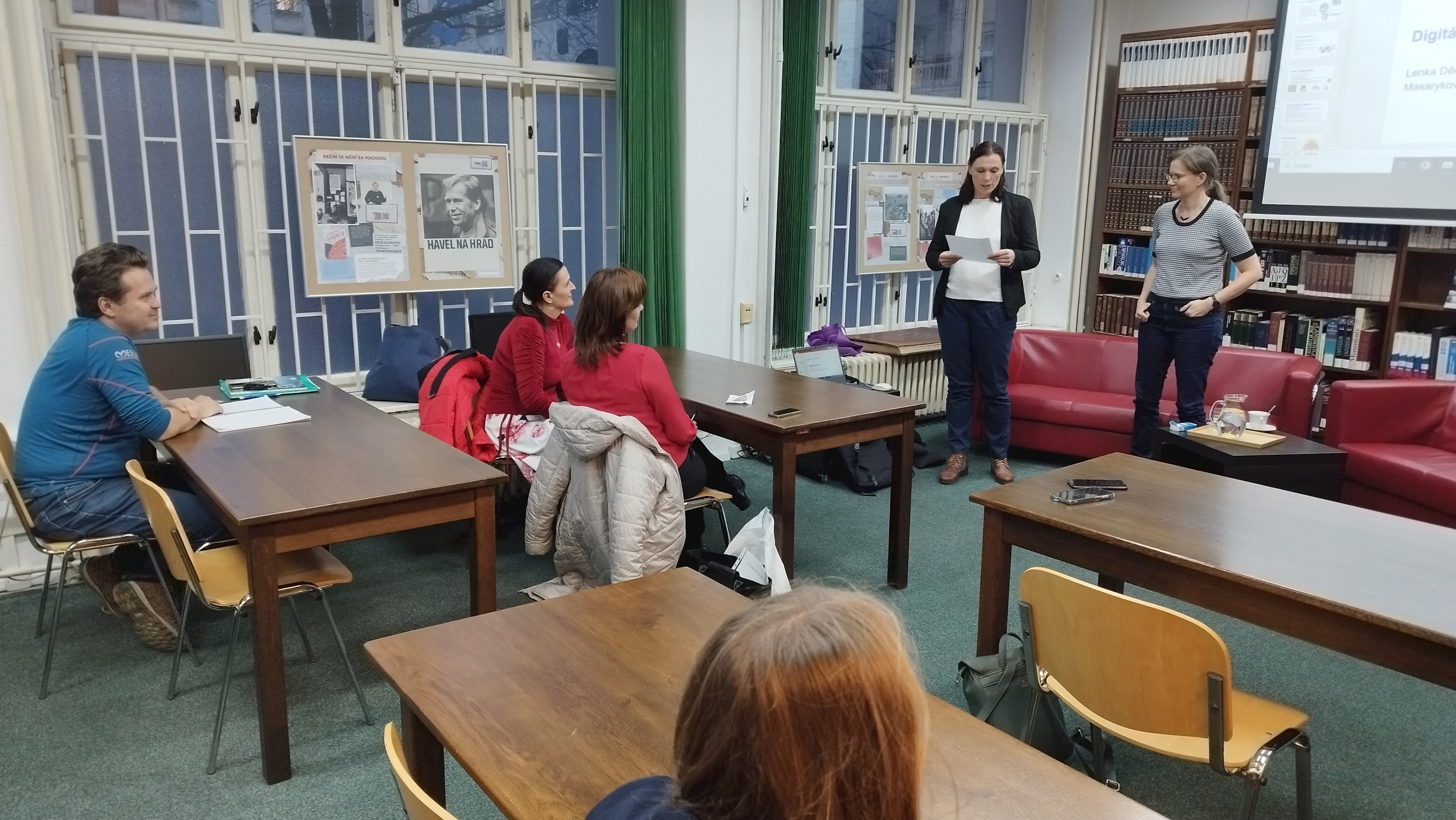
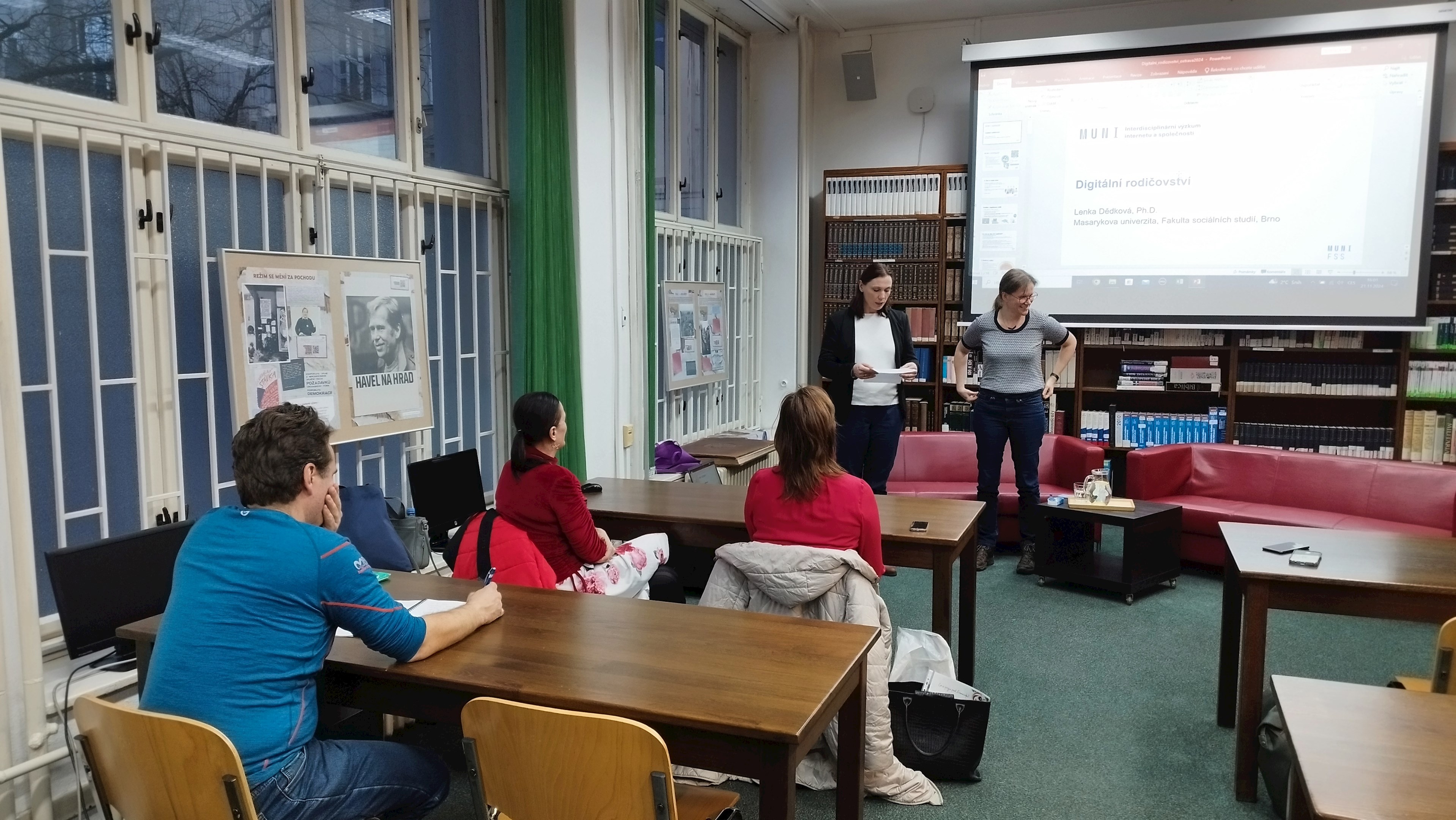
Lenka Dědková, the principal investigator of the PARKA project, spoke in Ostrava as part of the Digital Czechia Week. Her presentation focused on parenting children and adolescents in a digital world, including communication about technology, its impact on well-being, and critically reading media reports. She also introduced the first findings from the PARKA project, exploring what prevents adolescents from sharing unpleasant online experiences with their parents.